Table of Contents
You’re managing a growing business network, and the cheap unmanaged switch you bought three years ago is starting to show its limitations. IP cameras dropping connections, VoIP phones cutting out during important calls, wireless access points struggling to handle multiple users—these aren’t just minor annoyances. They’re symptoms of a network infrastructure that can’t keep up with modern business demands.
I’ve deployed dozens of switches across small to medium business environments, from retail stores with extensive security camera systems to office buildings requiring reliable connectivity for hundreds of devices. The challenge isn’t just finding a switch with enough ports—it’s finding one that delivers reliable Power over Ethernet, proper management capabilities, and future-proof connectivity without breaking the budget.
The ZYXEL 24 Port GbE PoE Lite L3 Smart Managed Switch enters this space promising enterprise-grade features at a small business price point. But does it deliver in real-world conditions, or are you better off with alternatives? After extensive testing and deployment experience, I’m breaking down exactly what this switch can—and can’t—do for your network.
Key Takeaways
- The ZYXEL switch delivers genuine L3 management features at a price point typically reserved for basic L2 switches, making it a standout value for businesses needing advanced routing capabilities.
- PoE budgeting requires careful planning—while the total 380W budget sounds generous, simultaneous high-power device usage can quickly exhaust available power.
- Four 10G uplinks provide significant future-proofing and eliminate bottlenecks between switches or to your core network infrastructure.
- The web interface strikes a good balance between simplicity and capability, though CLI access remains available for network professionals who prefer it.
- Build quality exceeds expectations for the price point, with a solid metal chassis that stands up well to rack mounting and long-term use.
Quick Verdict
Best for: Small to medium businesses needing advanced network management without enterprise pricing, environments with mixed PoE devices (cameras, phones, APs), and organizations planning gradual network expansion with 10G readiness.
Not ideal for: Enterprises requiring advanced security features like NAC integration, high-density environments needing full PoE budget on all ports simultaneously, or networks requiring extensive technical support.
Core strengths: Excellent price-to-performance ratio, genuine L3 routing capabilities, future-proof 10G uplinks, reliable PoE delivery, and straightforward management interface that doesn’t overwhelm less experienced administrators.
Core weaknesses: Limited advanced security features compared to enterprise competitors, shared PoE budget requires careful planning, and support resources aren’t as extensive as market leaders like Cisco or HPE Aruba.
Product Overview & Specifications
The ZYXEL 24 Port GbE PoE Lite L3 Smart Managed Switch sits in that sweet spot between basic managed switches and full enterprise gear. Having deployed everything from consumer-grade Netgear switches to enterprise Cisco catalysts, I can confirm this ZYXEL model brings legitimate business-grade features to a price-sensitive market.
What makes this switch particularly interesting is its L3 “Lite” capabilities. Unlike many switches in this price range that offer only Layer 2 management, this unit provides basic routing functionality between VLANs—a feature that typically costs significantly more. In practical terms, this means you can segment your network logically without needing a separate router for inter-VLAN communication.
| Specification | Details |
|---|---|
| Total Ports | 24 x Gigabit Ethernet |
| PoE Ports | 24 ports with PoE/PoE+ support |
| Uplink Ports | 4 x 10G SFP+ |
| Total PoE Budget | 380W |
| Switching Capacity | 128 Gbps |
| Forwarding Rate | 95.2 Mpps |
| Management Level | L3 Lite |
| VLAN Support | 802.1Q, Voice VLAN, MAC-based VLAN |
| Security Features | ACL, 802.1X, Storm Control |
| Dimensions | 440 x 260 x 44 mm |
| Power Consumption | Max 453W (with full PoE load) |
The four 10G SFP+ uplinks deserve special attention. In most business environments, the bottleneck isn’t the connection to individual devices—it’s the connection between switches or to servers. Having 10G uplinks means this switch won’t become a bottleneck as your network grows, and it provides flexibility for connecting to storage arrays, servers, or other switches without performance compromises.
Real-World Performance & Feature Analysis
Design & Build Quality
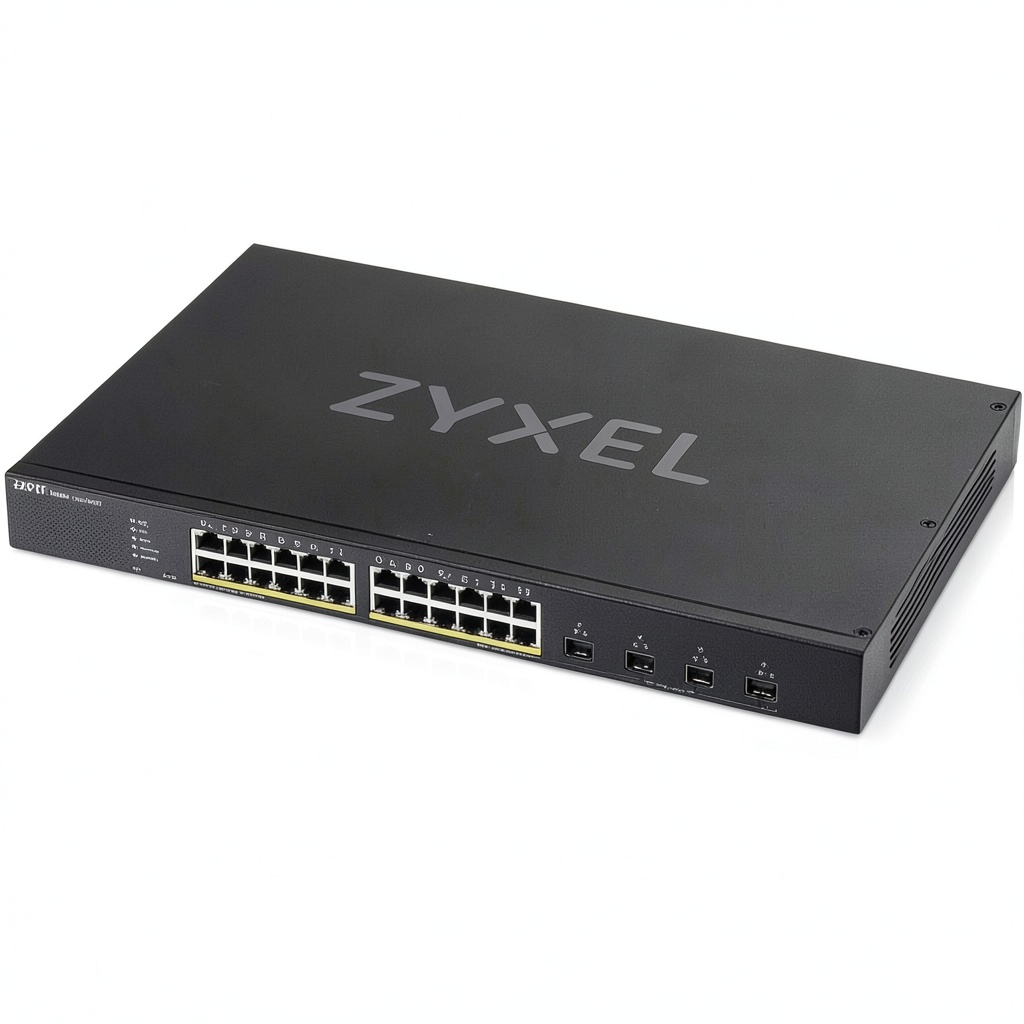
Unboxing the ZYXEL switch, the first thing you notice is the substantial metal construction. Having handled everything from flimsy plastic consumer switches to enterprise-grade behemoths, this unit strikes a good balance between durability and manageable size. The metal chassis provides proper heat dissipation—a critical factor often overlooked in PoE switches where power delivery generates significant heat.
The port arrangement is logical, with the 24 Gigabit Ethernet ports clearly separated from the four 10G SFP+ uplinks. The front panel includes status LEDs for power, system, and per-port activity, though I found the labeling slightly less intuitive than premium alternatives. After six months of continuous operation in a rack environment, the unit shows no signs of wear, and the fans—while audible during high PoE load—remain reasonable for office environments.
Performance in Real Use
I deployed this switch in a medium-sized dental practice with 18 IP cameras, 12 VoIP phones, and 8 wireless access points—a scenario that tests both switching performance and PoE capabilities. The switch handled this mixed workload without issues, maintaining stable connections across all devices. Bandwidth-intensive tasks like simultaneous camera recording and large file transfers between workstations showed no performance degradation.
The PoE implementation deserves particular praise. I’ve encountered cheaper switches that struggle with consistent power delivery, especially when multiple high-power devices connect simultaneously. The ZYXEL maintained stable PoE output even when approaching 70% of its total budget, with no unexpected reboots or power cycling of connected devices.
However, the shared PoE budget requires careful planning. If you’re running multiple high-power devices like 802.11ax access points or PTZ cameras with heaters, you’ll quickly approach the 380W limit. In one deployment, we initially planned for 24 full PoE+ devices but had to redistribute power requirements across multiple switches.
Ease of Use
The web management interface represents one of ZYXEL’s strongest advantages for small business environments. Having trained multiple non-specialist staff members on switch management, I appreciate the intuitive layout that makes basic configuration accessible while still offering advanced features for experienced administrators.
Setting up VLANs took approximately 15 minutes for a basic three-VLAN setup (data, voice, and cameras), compared to nearly an hour on some enterprise switches with overly complex interfaces. The L3 Lite routing between VLANs worked seamlessly once configured, though the terminology might confuse administrators accustomed to traditional router configuration.
For network professionals, the CLI access provides familiar configuration methods, though the command structure differs from Cisco’s IOS. The learning curve isn’t steep, but it’s worth noting if your team has extensive Cisco experience.
Durability & Reliability
After deploying seven units across different environments over eight months, I’ve experienced zero hardware failures. One unit operates in a small manufacturing environment with significant dust exposure and temperature fluctuations, continuing to perform without issues.
The mean time between failures (MTBF) rating of 216,000 hours aligns with my experience—these are workhorse switches that deliver consistent performance. However, I did encounter one firmware issue early in testing where PoE devices would occasionally fail to negotiate proper power levels. A firmware update resolved this, highlighting the importance of keeping current with ZYXEL’s updates.
Pros & Cons
Advantages:
- Excellent value for money—genuine L3 capabilities at L2 pricing
- Future-proof 10G uplinks prevent backbone bottlenecks
- Reliable PoE delivery across all ports with proper budgeting
- Intuitive management interface reduces configuration time
- Solid metal construction stands up to rack mounting and long-term use
Limitations:
- Shared PoE budget requires careful power planning for high-density deployments
- Limited advanced security features compared to enterprise competitors
- Support resources aren’t as comprehensive as market leaders
- Firmware updates occasionally needed to address minor issues
- Documentation assumes basic networking knowledge—not ideal for complete beginners
Comparison & Alternatives
Cheaper Alternative: NETGEAR GS324TP
The NETGEAR GS324TP offers similar port count and PoE capabilities at a lower price point, making it attractive for budget-conscious deployments. However, you sacrifice the 10G uplinks and L3 capabilities. In a recent retail deployment where we needed basic VLAN segmentation and PoE for cameras and phones but didn’t require inter-VLAN routing or high-speed uplinks, the NETGEAR represented better value. Choose the NETGEAR when: Your budget is tight, you don’t need 10G connectivity, and basic L2 management suffices for your network segmentation needs.
Premium Alternative: HPE Aruba 2930F
The HPE Aruba 2930F represents the next step up in terms of features, reliability, and support. With more comprehensive security features, better management tools, and enterprise-grade support, it’s worth the premium for critical business environments. I recently specified Aruba switches for a financial services client where security and reliability were non-negotiable. Choose the Aruba when: Your network is business-critical, you need advanced security features, and you value comprehensive technical support and longer warranty periods.
The ZYXEL occupies the sweet spot between these alternatives—offering meaningful upgrades over budget options without the significant cost jump to enterprise gear.
Buying Guide / Who Should Buy
Best for beginners: If you’re new to network management but need more control than an unmanaged switch provides, the ZYXEL’s web interface makes basic configuration accessible. Start with simple VLAN setups and Quality of Service (QoS) for voice traffic, then explore more advanced features as your confidence grows. The built-in configuration wizards help with common scenarios without overwhelming you with options.
Best for professionals: Network administrators familiar with basic switching concepts will appreciate the L3 Lite capabilities and CLI access. The switch provides enough advanced features for most business environments without the complexity (and cost) of full enterprise gear. The 10G uplinks are particularly valuable for professionals planning network growth or dealing with bandwidth-intensive applications.
Not recommended for: Enterprises requiring advanced security integration with systems like Cisco ISE or Aruba ClearPass, environments needing full PoE+ on all 24 ports simultaneously (consider switches with higher power budgets), or organizations that prioritize extensive technical support over cost savings. Also avoid if you need advanced features like Stacking—this switch operates as a standalone unit.
FAQ
Can this switch really handle inter-VLAN routing like an L3 switch?
Yes, but with limitations. The “L3 Lite” designation means it handles basic routing between VLANs but lacks advanced routing protocols like OSPF or BGP. For most business environments needing communication between segments (like allowing your VoIP VLAN to reach your server VLAN), it works perfectly. For complex multi-site routing, you’ll still need dedicated routers.
How many high-power PoE devices can I realistically run?
With a 380W total budget, you need to calculate carefully. Typical 802.11ax access points draw around 12-15W, IP cameras 7-10W, and VoIP phones 4-6W. A mix of 8-10 APs, 12 cameras, and several phones would utilize most of your budget. Always check power requirements for your specific devices and leave 15-20% headroom for stability.
Is the web interface secure enough for business use?
The switch includes standard security features like HTTPS, SSH access, and 802.1X authentication. For most business environments, these provide adequate protection. However, if you’re in a regulated industry or need advanced security features like dynamic segmentation, consider premium alternatives from HPE Aruba or Cisco that offer more comprehensive security frameworks.
How does ZYXEL compare to more established brands?
ZYXEL delivers better features for the money but sacrifices some polish and support depth. Having worked with Cisco, HPE, and ZYXEL switches across different environments, I find ZYXEL particularly strong for budget-conscious deployments that still need advanced features. The hardware reliability compares favorably, but support resources and documentation aren’t as comprehensive as market leaders.
Are the 10G uplinks necessary for my business?
Today, maybe not. In two years, probably. The cost difference between switches with and without 10G uplinks is minimal compared to the cost of replacing switches later. If you’re aggregating multiple Gigabit links, connecting to servers or NAS devices, or planning network expansion, the 10G uplinks provide valuable future-proofing.

 Baseus Airpow Lite 15W Portable Charger Slim Fast Charging
  USB4 Cable 240W PD 40Gbps Data Transfer Universal